
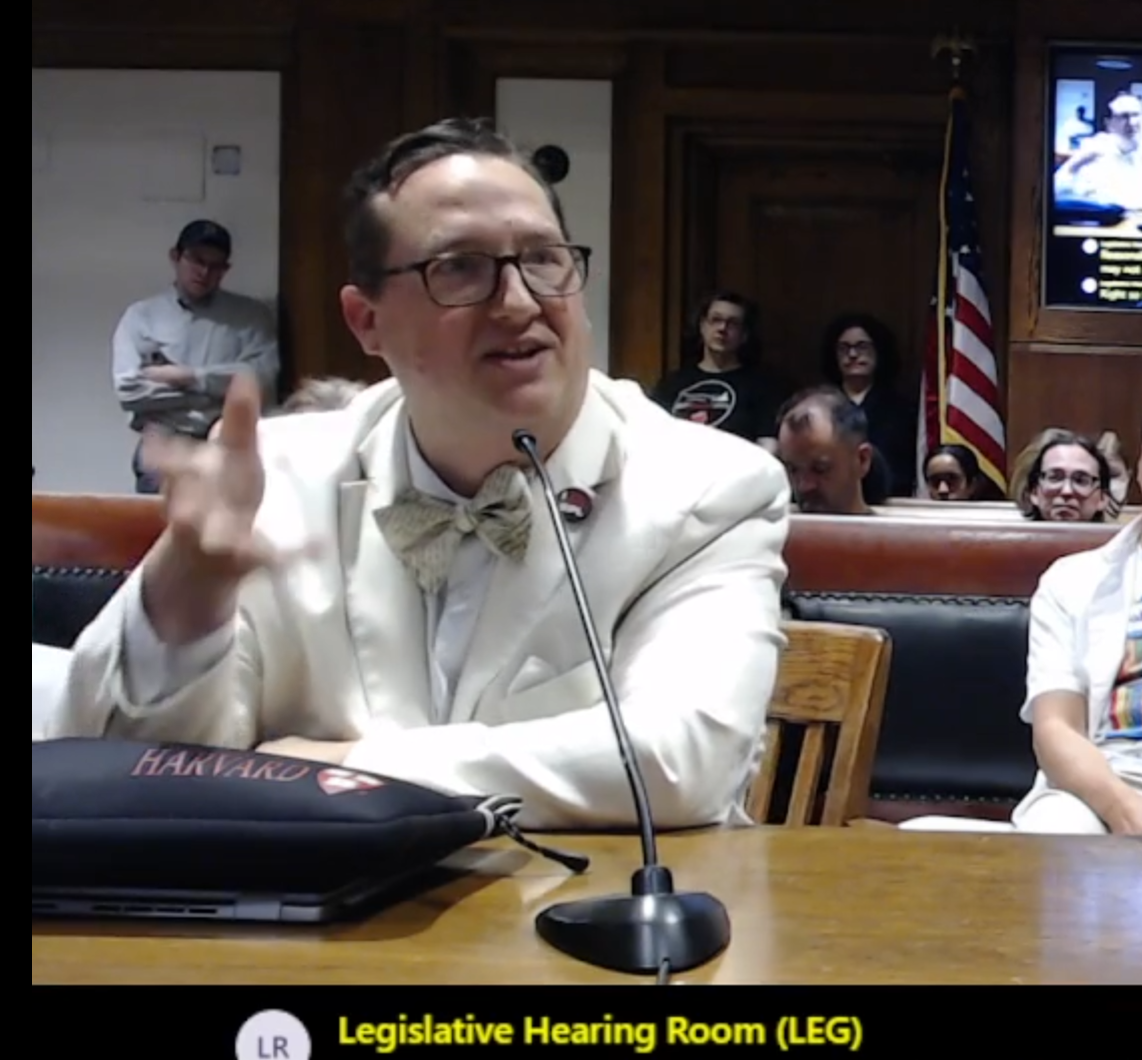
This week, I had the opportunity to testify before the Massachusetts Joint Committee on Tourism, Arts and Cultural Development in support of two important bills: H.3595 and S.2330. These bills would establish a state special commission to study and recommend solutions to one of the most urgent and persistent challenges facing libraries today: the non-negotiable, restrictive rental agreements imposed by publishers. These eBook rental agreements erode library budgets, limit public access, and ultimately undermine the very mission of libraries.
For those of us working at the intersection of law, libraries, and digital policy, the moment is both frustrating and full of opportunity. Frustrating, because for more than a decade, libraries have been sounding the alarm about exploitative digital licensing practices, only to be met with delay or denial. But it’s also an opportunity: states are beginning to listen. And Massachusetts now has the chance to take up Connecticut's recent eBooks win, and move forward.
The Rental Trap: How eBooks Undermine Library Values
Massachusetts libraries, like the libraires in the rest of the U.S., are being forced to rent digital books under overly restrictive terms that substituting the publisher’s priorities for the library's mission. Unlike print materials, which are purchased once and owned in perpetuity, eBooks are typically acquired through restrictive rental agreements that limit access, loans, interlibrary loans, and impose artificial expiration dates, and inflate costs.
The current eBook licensing system functions like a punishment tax on libraries. Publishers routinely charge libraries three to ten times the consumer price for the exact same digital title—simply because libraries serve the public. This pricing structure penalizes libraries for their mission of broad, equitable access. And because these licenses often expire after a set time or number of checkouts, libraries are forced to re-rent the same titles again and again, draining limited budgets. The result isn’t just inefficiency—it’s exclusion. Money spent re-leasing yesterday’s bestsellers leaves little room to acquire new, diverse, or community-specific materials. Libraries are trapped in a cycle that serves neither sustainability nor public interest.
The result is a cycle of perpetual rental, with no parity, no permanence, and no ownership. Libraries become forced renters in a market controlled by a small group of publishers—digital landlords who can raise prices, restrict access, and shift terms unilaterally, with little to no recourse. This "digital landlordism" undermines the core mission of libraries: to provide equitable, durable, and public access to information.
The convenience of eBooks should not come at the expense of the public’s right to lasting, equitable access to library-acquired materials that the Commonwealth has funded.
How We Got Here (Briefly): Federal Limits, State Innovation
States like Maryland and Connecticut have already taken some action. Maryland passed an eBook access law in 2021, but it was struck down in Association of American Publishers v. Frosh, 582 F. Supp. 3d 96 (D. Md. 2022), on the grounds that it was preempted by the federal Copyright Act. The lesson from Frosh was clear: state action must be carefully tailored to avoid interfering with federally granted rights.
That’s where new eBooks law, Connecticut’s 2025 Public Act No. 25-9, stands out. After three years of collaboration, eBook Study Group was proud to work with Connecticut legislators and library leaders to help craft this bill, which bans library eBook contracts containing specific unfair terms, including access, confidentiality clauses, or bans on interlibrary loan. Importantly, the CT law now includes a multi-state trigger: it only takes effect once similar laws are passed in states representing at least seven million people.
Legal Tools: Yes, States Can Act
Opponents often claim that only Congress can fix this eBooks problem. That’s wrong. States have long-standing authority over contracts, commerce, and procurement. The eBooks Study Group has developed specific legislation for states that avoids federal preemption by steering clear of copyright, and focusing on the the fairness of these eBook rental contracts offered to libraries. Our approach is grounded in the same principles that allow states to regulate insurance, lending, and consumer protection.
This strategy aligns with state procurement policy, too: governments should expect a reasonable return on investment when spending public funds. Public dollars should not go to rental licenses that evaporate, restrict, or undermine the very public institutions they are meant to serve.
Why a Commission Is the Right Next Step
The bills before the Massachusetts legislature don’t create new regulation (yet!) What they do is create a framework: a Special Commission to gather data, consult stakeholders, and recommend a lawful, balanced, and effective way forward. It’s a strategic first step, and a vital one.
It is also a chance to acknowledge the decades of work Massachusetts libraries have already done. I am proud to have worked with folks from the Massachusetts Library Association, the Massachusetts School Library Association, the Boston Public Library, and many, many others. Massachusetts librarians, patrons, lawyers have testified on this issue, submitted pricing data, and met with lawmakers again and again. The evidence of harm is already there. The Commission is not about proving that a problem exists, we know it does. It’s about charting a path to fix it!
And one of the most important reasons to establish this Commission is to help protect libraries, and the public they serve, from the overwhelming influence of the publishing industry.
Major publishers bring enormous financial power to the table. These are billion-dollar corporations with the resources to fund full-time lobbying teams, litigation strategies, and sophisticated public relations campaigns. Libraries, by contrast, are taxpayer-funded institutions committed to public service, transparency, and stewardship, not profit. When negotiating eBook terms, this power imbalance is not just apparent, it’s defining.
In recent years, publishers have used this imbalance to dictate terms to libraries without negotiation. These include skyrocketing license costs, arbitrary usage restrictions, and confidentiality clauses that prevent libraries from even comparing prices. And when libraries or lawmakers push back, publishers are quick to respond with legal threats or lobbying pressure, especially at the state level, where policymaking is more accessible and responsive.
The Commission proposed gives Massachusetts a structure to push back. It creates a public, transparent process for investigating pricing, licensing terms, and the legal landscape. It enables the Commonwealth to hear from librarians, legal scholars, procurement officials, authors, and yes, even publishers, but in a setting where the rules of engagement are not dictated by the most powerful voice in the room.
This Commission would help restore balance to a digital content market that has tilted far too heavily toward private corporate interest. It would empower Massachusetts to act not as a passive buyer, but as a thoughtful policymaker, on behalf of every library, every patron, and every taxpayer in the state.
Massachusetts Can Carry the Momentum Forward
With federal funding in question and local budgets under strain, the Commonwealth has both the opportunity and the responsibility to act. We don’t need to wait for Congress. We have the legal authority, the policy momentum, and—most importantly—the moral obligation to lead.
The eBooks Commission proposed in H.3595 and S.2330 is how we begin.